You Have to Learn How to Be Bored Again

Remember being bored as a kid?
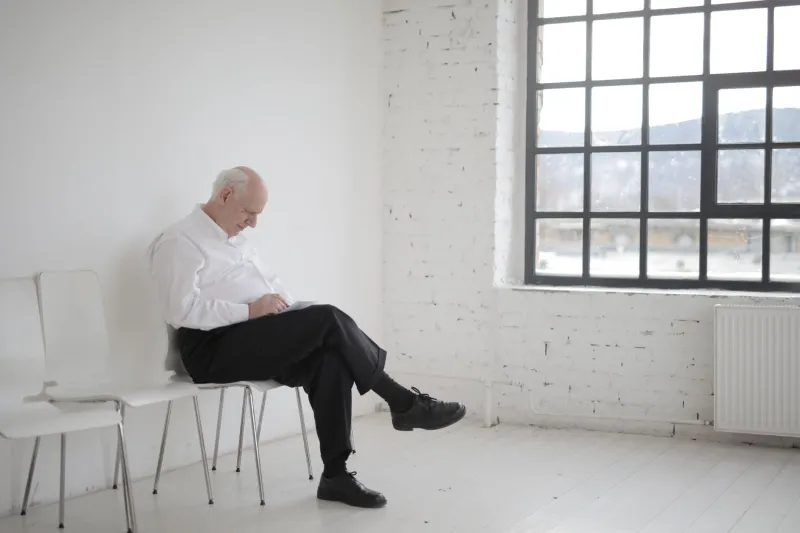
Not the performative boredom you'd announce to your parents on a Sunday afternoon hoping it would produce a trip to Blockbuster. Real boredom. The kind where you'd lie on the carpet and stare at the ceiling and your brain would just... drift. You'd invent elaborate games with household objects. You'd daydream. You'd arrive at ideas from absolutely nowhere, the way you can only arrive at things when there's no destination.
For a lot of people under thirty, that experience is becoming a stranger. And the consequences are stranger than you'd expect.
The Stimulation Trap
Let's be clear about what we're actually talking about, because "too much screen time" is the kind of observation that stopped being useful around 2015.
This isn't about screens. It's about the architecture of attention that screens have built — and that we've come to inhabit so completely we've stopped noticing it.
The average American checks their phone 144 times per day. That number is higher for people under 25. More importantly, the gaps between interactions have narrowed to almost nothing. The moment of waiting — for a friend to arrive, for the elevator, for your brain to have a thought that wasn't prompted by something external — has been systematically colonized by content.
And here's what nobody in the conversation about screen time really talks about: those gaps weren't wasted time. They were where a lot of the good stuff happened.
Neuroscientists call it the default mode network — the brain state that activates when you're not focused on a task. It's associated with creativity, self-reflection, empathy, and the kind of long-range thinking that lets you imagine futures that don't currently exist. It's essentially the brain doing its most important background processing.
And it requires boredom to activate. Not meditation. Not a walk with a podcast. Actual, unstructured, unstimulated emptiness.
Hollow Expertise and the Creativity Problem
Here's the paradox worth sitting with: we are producing a generation of people who are, by many metrics, incredibly skilled.
Gen Z is more educated than any previous generation. They're digitally fluent in ways that make older workers look like they're operating in a different century. They can learn new tools fast, communicate across platforms, build audiences, and execute tasks with impressive efficiency.
But creativity — the kind that generates genuinely new ideas rather than remixing existing ones — requires something that efficiency actively resists. It requires the mind to wander far enough from the familiar to return with something strange.
That wandering needs space. It needs boredom.
Adobe's State of Creativity research has repeatedly found that people who report having regular "idle time" — unstructured, unprogrammed downtime — score higher on creative problem-solving than those who don't. And this isn't a personality thing. It's a practice thing. The idle time isn't just correlated with creativity. It's producing it.
When we eliminate the empty moments, we don't just lose comfort with boredom. We lose the cognitive territory where original thought is generated. What's left is competent, technically impressive, and fundamentally derivative.
Hollow expertise. Polished surface. Nothing underneath.
Identity in the Scroll
There's another cost that's harder to quantify and maybe more important.
Knowing who you are — actually knowing, not knowing what you'd answer if someone asked — requires a certain amount of time alone with your own mind. Not consuming. Not producing. Just being with the low-grade weirdness of your own interior.
For a lot of young people, that's the most uncomfortable thing imaginable. And that discomfort isn't incidental. It's a symptom.
When you've grown up in an environment where every quiet moment is immediately filled with external input, the quiet starts to feel like a threat. The absence of stimulation registers as something wrong, something to be corrected. And so you correct it — reflexively, automatically, before you even realize you've done it.
The result is a generation that knows an enormous amount about the world and relatively little about themselves. Not because they're shallow, but because the infrastructure for self-knowledge — uninterrupted time with one's own thoughts — has been quietly dismantled.
You can't build a coherent sense of self in the margins between notifications. You need longer stretches. You need the boring ones.
Boredom as Practice
The good news, if you want to call it that, is that this is a learnable skill. It's not a personality trait you either have or don't.
Boredom tolerance, like most things, responds to practice. The brain can relearn how to be unoccupied. It just resists at first — sometimes loudly.
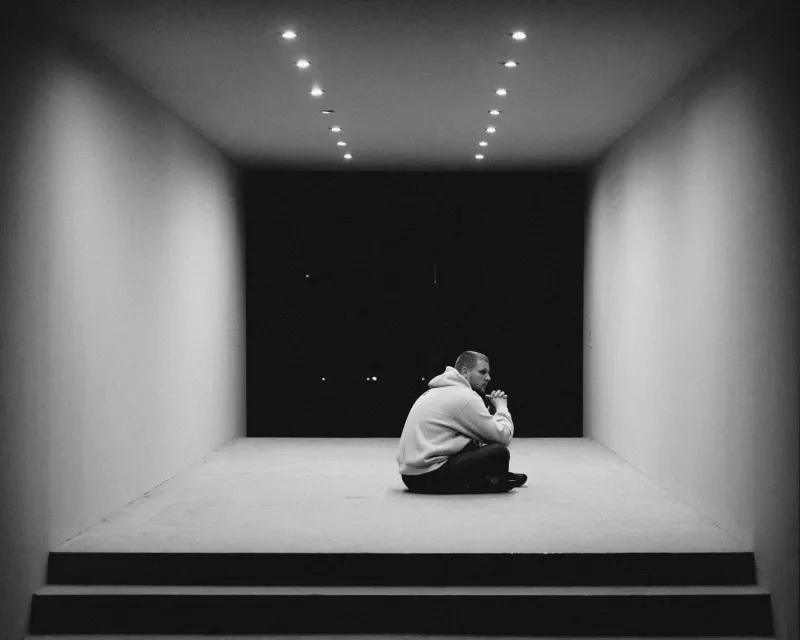
Start small. Leave your phone in another room for thirty minutes with nothing to replace it. No book, no podcast, no task. Just the room and your brain. Notice what happens. Notice the discomfort. Notice what comes after the discomfort, if you wait long enough.
For most people, what comes after is surprisingly interesting. A memory surfaces. An idea appears from nowhere. A problem you've been stuck on shifts slightly. Not because you were trying to solve it — because you stopped trying.
The void isn't something to fill. It's something to use.
What We Lose When We Optimize Emptiness Away
We're not going to reverse the attention economy. That's not the argument here.
But there's something worth naming about what we lose when we accept a world where no moment is allowed to be empty — where boredom is treated as a design failure to be corrected by the next app, the next feature, the next piece of content engineered to capture the idle second before it becomes something else.
We lose the part of ourselves that only shows up when there's nothing else to show up instead.
For younger generations especially, reclaiming boredom isn't nostalgia. It's not about putting down the phone and going outside. It's about recognizing that the ability to be with nothing — genuinely nothing, not curated nothing — is one of the most radical and necessary skills available.
Because the alternative isn't fullness. It's just a very sophisticated kind of empty.