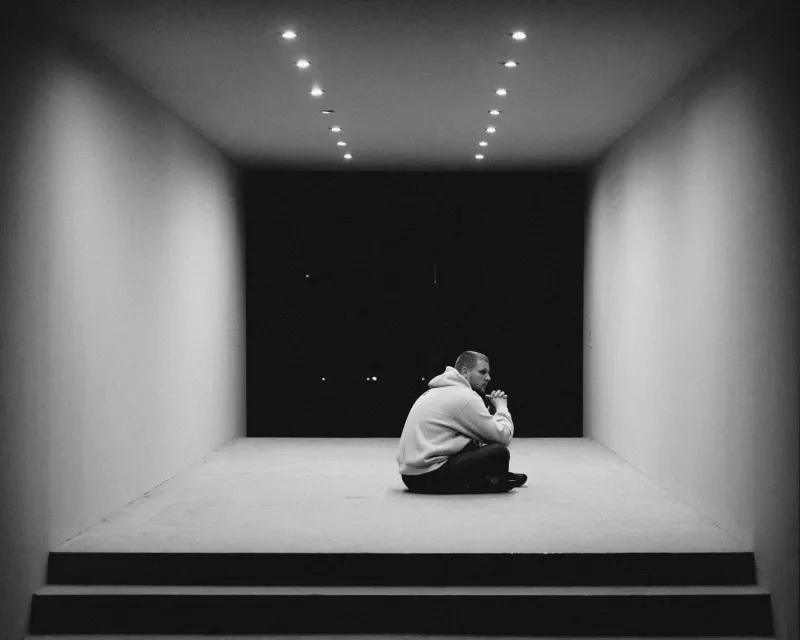
What We're Really Saying When We Can't Stop Talking
It happens within seconds. The conversation hits a natural pause — a breath, a lull, the end of a thought — and something in the room shifts. Someone laughs a little too quickly. Someone reaches for their phone. Someone starts a sentence they clearly didn't plan, just to fill the space.
We are, collectively, terrible at silence.
Not silence in general. Most of us are fine sitting quietly alone, working through a problem, reading a book, staring at a wall. But silence with another person — that's a different animal. It has weight. It has texture. And in American social culture specifically, it tends to feel like a failure.
The Awkward Pause as Cultural Artifact
The phrase "awkward silence" is so embedded in everyday speech that we rarely stop to ask what makes it awkward, exactly. The silence itself isn't doing anything. It's not hostile. It's not an accusation. It's just... the absence of words for a moment.
But we treat it like a problem that needs solving.
Researchers who study conversation dynamics have found that in American English, the average tolerance for silence in social interaction is somewhere around four seconds before someone moves to fill it. Four seconds. That's barely enough time to take a full breath.
Other cultures sit with quiet very differently. In Finland, silence in conversation is often a sign of respect — it means you're actually thinking about what was just said rather than preparing your response while the other person is still talking. In Japan, ma (間) — the concept of meaningful pause or negative space — is woven into communication, art, music, and architecture. The gap is not empty. It's part of the structure.
In the US, the gap is a glitch.
Noise as Social Armor
Here's the uncomfortable question: what are we actually afraid of when silence enters the room?
One answer is evaluation. When we're talking, we have some control over how we're perceived. We're presenting. The silence strips that away and leaves us just... present. Which, for a culture that has thoroughly conflated self-worth with performance, is genuinely unsettling.
Another answer is intimacy. Real silence — the comfortable kind, not the panicked kind — requires a certain level of trust. It means both people have agreed, without saying so, that they don't need to be entertaining each other right now. That just being in the same space is enough. That's a vulnerable place to be with someone you don't fully know, or even with someone you think you do.
Filling the silence keeps the relationship at a manageable distance. You can talk with someone for hours and never actually arrive anywhere close to them if you fill every gap with noise.
The Performance of Connection
Social media has not helped any of this. Platforms reward constant output — the quick take, the hot response, the rapid-fire comment thread. We've trained ourselves to treat every moment of quiet as a prompt for content. The skill of sitting with an unresolved thought, of letting a conversation breathe, has been quietly deprioritized in favor of the skill of always having something to say.
This bleeds into in-person interaction in ways that are hard to notice until you're paying attention. Conversations increasingly feel like parallel performances rather than genuine exchanges. Two people taking turns presenting while the other waits for their moment. The silence between turns is the enemy because it's the moment when the performance stops and something less rehearsed might surface.
The irony is that what most of us are actually looking for in connection — the sense that someone genuinely sees us, that we're known rather than just heard — tends to live in exactly the spaces we're most aggressively filling.
What Silence Actually Communicates
Comfortable silence is one of the more reliable indicators of a real relationship. It's not nothing. It's the presence of enough trust that you don't need to perform for each other right now.
Think about the conversations that have actually mattered to you — the ones you still think about. Chances are they had pauses. Moments where someone said something real and you both just sat with it for a second before responding. Those pauses weren't awkward. They were the conversation working correctly.
There's also something to be said for what silence reveals about listening. When you're genuinely listening — not just waiting to talk — you don't rush to fill the space when someone finishes a thought. You let it settle. You might not respond immediately because you're actually processing what was said. That kind of listening has become rare enough that people notice it when they experience it. It feels like being taken seriously.
Practicing the Pause
This isn't really about learning to be more comfortable with awkward silences at networking events or first dates. Those situations have their own logic and their own anxieties.
This is about something simpler: noticing the impulse to fill every gap and occasionally choosing not to.
Let a conversation breathe. Resist the reflex to bridge every pause with a new topic. When a friend says something that lands, don't immediately pivot to your own version of the same story. Just let what they said exist for a moment.
You might be surprised what shows up in the space you leave open.
Silence isn't the opposite of connection. A lot of the time, it's the point where connection actually starts — once both people have stopped talking long enough to let something real through.
The void, it turns out, is not empty. It's just waiting for you to stop filling it.