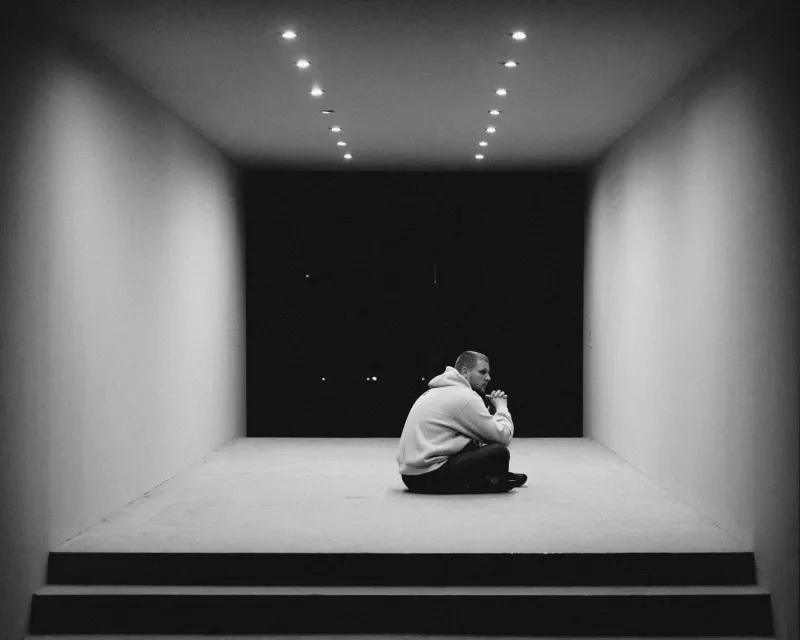
Infinite Options, Zero Output: The Creative Cost of Having Everything Available
You open the streaming app and scroll for twenty minutes. Nothing feels right. Everything is available and nothing is compelling. You close the app and watch something you've already seen.
You sit down to write and open a blank document. The cursor blinks. An hour passes. You haven't written anything but you've downloaded three new writing apps, read four articles about writing habits, and reorganized your desktop.
You want to start a creative project but first you need to figure out your niche, your aesthetic, your tools, your platform, your audience, your brand. By the time you've figured all of that out, the energy that wanted to make something has quietly left the building.
This is the blank canvas problem. And it's not about laziness. It's about how the human brain actually responds to unlimited possibility.
The Paradox Nobody Warned You About
In 2000, psychologists Sheena Iyengar and Mark Lepper ran a study that has since become one of the most cited experiments in behavioral economics. They set up tasting booths at a grocery store — one with 6 varieties of jam, one with 24. The larger display attracted more interest. But shoppers who encountered the smaller display were ten times more likely to actually buy something.
More options. Less action. The paradox has been replicated across dozens of contexts since then — retirement savings plans, consumer goods, medical decisions, dating apps. The pattern holds: past a certain threshold, more choice doesn't expand what we do. It freezes us.
Psychologist Barry Schwartz called this the paradox of choice, and his core argument is both simple and quietly devastating: the more options we have, the higher our expectations climb, the more we second-guess our decisions, and the less satisfied we are with whatever we choose — even if it's objectively fine.
Now apply that to the creative life, where the stakes feel personal, where the fear of making the wrong choice is inseparable from the fear of making bad work, and where the number of available options has expanded to something close to infinity.
When Freedom Becomes Its Own Cage
The tools available to a person who wants to make something today are genuinely staggering. You can record, produce, and distribute music from a laptop. You can write and publish a book without a publisher. You can build an audience for almost any creative work without any institutional gatekeeper saying yes first.
This is real. It matters. The democratization of creative tools is not a small thing.
But there's a shadow side that we don't talk about as much: when everything is possible, nothing feels inevitable. And creative work often needs a feeling of inevitability to get started.
Constraints create that feeling. When you can only do this one thing with these limited tools in this narrow window of time, you stop deliberating and start making. The constraint isn't an obstacle to the work. It is the work, in the sense that it defines the shape of what you're making.
A poet writing in a fixed form — a sonnet, a villanelle — isn't limited by the form. They're guided by it. The form makes thousands of micro-decisions for them so they can focus on the decisions that actually matter. The constraint is not the enemy of expression. It's the scaffolding that makes expression possible.
The Self-Optimization Spiral
There's a specific version of the blank canvas problem that has emerged in the last decade and it's worth naming directly: the self-optimization spiral.
The premise goes like this. You want to be more creative, more productive, more focused. So you research the best systems for achieving this. You find five competing frameworks. You try to synthesize them. You buy the tools each one recommends. You spend significant time optimizing your optimization system. Your actual creative output during this period: zero.
This is not a niche problem. There are entire industries — productivity software, self-help publishing, the personal development corner of YouTube — built around the premise that the right system will unlock your potential. And they keep expanding, which means there are always more systems to evaluate, more tools to try, more approaches to consider.
The blank canvas of how to work has become as paralyzing as the blank canvas of what to make.
Reintroducing Useful Edges
The solution isn't to pretend constraints are fun or to romanticize scarcity. It's to recognize that constraints are doing actual cognitive work — and to start designing them deliberately instead of waiting for circumstances to impose them.
Some frameworks that are worth considering:
The single-tool rule. Pick one tool for a creative project and don't evaluate alternatives until the project is done. Not because your tool is the best one. Because decision fatigue is real and every hour spent comparing tools is an hour not spent making anything.
The time box. Give yourself a fixed, non-negotiable window — ninety minutes, two hours — and treat everything made inside that window as the work, regardless of quality. The constraint of time forces you past the deliberation phase and into the doing phase.
The format constraint. If you're writing, pick a length and stick to it. If you're making music, pick a tempo and a key and don't change them. Arbitrary constraints feel arbitrary until you're working inside them, at which point they start to feel like the natural shape of the thing.
The subtraction question. Instead of asking what you could add to a project or a practice, ask what you could remove. What's the minimum viable version of this? What happens if you take out one more element? Subtraction is underrated as a creative move.
Zero as a Starting Point
There's something almost paradoxical about the blank canvas problem: the solution to having too many options is often to deliberately choose nothing — to strip the field back to near-zero and then add only what's necessary.
This is, in a way, the oldest creative principle there is. Constraints aren't the opposite of creativity. They're the condition under which creativity tends to do its best work.
The next time you're sitting in front of a blank document or an empty afternoon or an open-ended creative brief and feeling that familiar freeze — consider that the problem might not be that you don't know what to make. It might be that you've left yourself too many ways to make it.
Remove some. See what's left.
That's usually where the work actually lives.