One Screen Was Enough: The Hidden Cost of Your Expanded Setup
There's a specific kind of satisfaction that comes from setting up a new workstation. The cables routed just right. The monitors angled at exactly the right degree. A productivity YouTube video playing in one corner because, apparently, watching someone else be productive is now part of being productive. You sit back, look at the whole arrangement, and feel something close to accomplishment.
You haven't done anything yet. But it feels like you have.
That feeling is the trap.
More Surface, More Drift
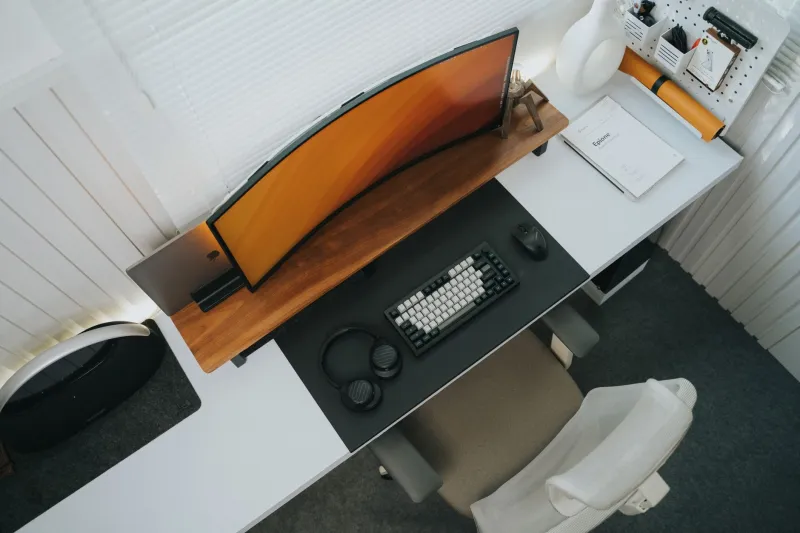
The logic behind dual monitors—and triple monitors, and ultrawide curved displays, and all the rest—is seductive because it sounds correct. More screen real estate means more things visible at once. More things visible means less switching. Less switching means more efficiency. The math seems to check out.
Except human attention doesn't work like screen resolution. It doesn't scale up just because you give it more room. What actually happens when you expand your visual field is that you expand the number of things competing for your focus at any given moment. That Slack thread in the corner isn't invisible just because you're not actively reading it. Your peripheral vision catches motion. Your brain registers new messages. The cognitive load of not looking at something is surprisingly high when that something is right there, glowing, twelve inches from your face.
This is what researchers call attention residue. Every time your eyes drift to a second screen—even briefly, even involuntarily—a fragment of your working memory follows. You return to your primary task carrying a little less of yourself than you left with. Do that forty times in an hour and you haven't multitasked your way to efficiency. You've just spread yourself thin across a wider surface.
The App That Fixes the App
The hardware problem has a software mirror. At some point, most of us started adding tools to manage our tools. A task manager to organize the tasks we're already tracking in our calendar. A focus app to block the distractions created by the communication app. A note-taking system to capture the ideas generated while avoiding the project manager.
Each addition made sense in isolation. Together, they form an ecosystem that requires constant maintenance. You spend time deciding where to put a thought before you've fully finished thinking it. You check four different places to figure out what you're supposed to be doing. The system meant to reduce friction has become its own source of friction—just more organized-looking friction.
This is the optimization paradox in its purest form. Every new layer added to improve output creates overhead that quietly taxes the very output it was meant to protect. You don't notice the tax because it's distributed across a hundred small moments. A glance here. A click there. A thirty-second debate about whether this note belongs in Notion or Obsidian. None of it feels like lost time. All of it is.
What Subtraction Actually Does
There's a reason the most focused work most people ever do happens in constrained environments. A flight with no Wi-Fi. A coffee shop with a dying laptop battery. A power outage that leaves you with a notebook and a pen and nowhere else to go.
Constraint forces commitment. When you only have one window open, you're in that window. When you only have one tool, you use that tool instead of evaluating whether it's the right tool. The decision fatigue that normally bleeds into your working hours evaporates because there are no decisions left to make. You just do the thing.
This isn't nostalgia for analog life. It's an observation about cognitive load and what happens when you remove it. The blank document is faster than the perfectly organized project dashboard because the blank document asks nothing of you except the work itself.
Trying the Subtraction
Unplugging the second monitor feels wrong at first. The desk looks lopsided. You keep reaching for windows that aren't there. The first day is genuinely uncomfortable, which is itself informative—discomfort at having less is a signal worth paying attention to.
But within a few days, something shifts. Tasks that previously required an hour start finishing in forty minutes. Not because you're working harder, but because you're working without the constant low hum of ambient distraction. The single screen becomes a kind of commitment device. This is the thing you're doing. This is the only thing visible. The choice has already been made.
You can run the same experiment with software. Pick one tool for notes. One tool for communication. Let the others go quiet. The goal isn't to be primitive—it's to stop mistaking the arrangement of tools for the doing of work.
The Void Has Better Bandwidth
Only Zero is a website about subtraction, so it would be convenient if the conclusion here were simply get rid of everything. But that's not quite it.
The point is that more—more screens, more apps, more systems—is not neutral. It carries weight. And most of us are carrying that weight without ever consciously choosing to pick it up. We added the second monitor because everyone else did. We downloaded the app because a newsletter recommended it. We built the system because the system felt like progress.
Real speed, it turns out, looks a lot like emptiness. One window. One task. One hour where the only thing on your screen is the thing that actually needs to get done.
The setup that looks like the least impressive one in the office might be producing the most. You won't be able to tell from the outside. That's kind of the point.